Welcome!
This page includes frequently asked questions about California's budget and its impact on the Irvine Unified School District. Queries are grouped by topic, and many include links to detailed graphics and charts.
For budget news and updates, be sure to visit the news center.
State Funding
What can we expect for the next fiscal year?
The IUSD Board of Education voted to adopt a budget for the 2013-14 school year on June 25, and for the first time in years the forecast for Irvine and other districts looked relatively bright.
John Fogarty, the district's assistant superintendent of business services, said IUSD's spending plan was based on the latest projections out of Sacramento, where Governor Jerry Brown and the Legislature recently reached agreement on a brand new funding formula for K-12 education.
The new model provides a base level of funding for school districts while providing additional dollars for English-language learners, students in foster care and students who are eligible for free and reduced-price lunches. Fogarty said it is expected to generate approximately $315 per student in additional revenues for IUSD.
Though there are a number of details to be revealed, including the unveiling of a new accountability system, the extra funding would appear to begin an era of recovery for California's public schools after years of devastating cuts.
At the same time, he said, a convoluted accounting requirement from the state will prompt IUSD to dig into its reserves for one more year. Here's why:
During the economic downturn, Irvine fell into an alternate funding formula known as Basic Aid, in which a district is funded by its own property taxes. This usually means more revenue, but in the interest of equity, the state decided in 2009 that it would scoop away any extra funding from Basic Aid districts. Because California waits a year to take these dollars, IUSD will be stripped of about $10 million for the 2012-13 school year sometime in 2013-14, Fogarty said.
With that in mind, the spending plan approved for IUSD outlines $233.2 million worth of expenditures - both restricted and unrestricted - against $225.7 million worth of total revenue. The difference will be offset by reserve set-asides, but Fogarty predicted that positive ending balances will return in 2014-15 and 2015-16, marking the end of deficit spending.
Why does IUSD adopt its budget so early? Considering the state of California often approves its spending plan later, how do school districts like Irvine even know how much revenue will be available for the next fiscal year?
In short, our state's budgeting system is a bit backwards.
Irvine and other school districts in California are required to submit their annual spending plans on or before June 30, but major decisions must be made much sooner.
For example, teachers must be notified by March 15 if the possibility exists that they will not be employed the following year. In addition, March also marks the deadline for IUSD to certify its Second Interim Report, indicating our district's ability to meet all financial obligations for the current year and two subsequent years. If IUSD is unable to show a balanced budget by this date, it must file the report as "qualified," and that designation can bring a number of consequences including sanctions and/or county intervention.
Interestingly enough, the state shares our June 30 deadline for budget adoption, but legislative leaders often don't meet it, forcing local school districts to file their budgets based on the governor's proposals from January and May. Once the state officially adopts its spending plan in the summer or fall, IUSD has 45 days to make any necessary adjustments.
To view a list of important dates on the road to budget adoption, click here.
How much of IUSD's budget is spent on people?
The Irvine Unified School District spends more than 93 percent of its operational budget on staff. This number holds critical importance when budget cuts are necessary, and it makes midyear cuts nearly impossible as many of our employees are contracted for the full year.
To see the percentage of total expenditures on employee compensation since 2005-06, click here.
How much does IUSD's food services program cost the district?
In 2008-09, IUSD's Nutrition Services program became self-sustaining, meaning it did not require contributions from the general fund. This was a tremendous accomplishment given the relatively small number of students who qualify for federally subsidized meals. District officials have credited the highly efficient Nutrition Services staff, as well as the computerized LunchBox point-of-sale system for the cost decreases.
To see the history of Nutrition Services expenditures since 2004-05, click here.
IUSD has been touted in recent years for its aggressive energy-savings campaign. How much has the district saved?
Over the past several years, IUSD staff has worked diligently to capture as many dollars as possible through energy savings and conservation. While the district earned headlines for a historic plan to bring solar energy to 16 sites - the savings has been conservatively estimated at $8 million over 20 years - the day-to-day actions of students and staff have already brought great savings.
From 2007-08 to 2008-09, IUSD saw its kilowatt usage drop from nearly 23.5 million to 22.2 million, for a savings of nearly $133,000 - and this comes despite a significant rate hike.
For a four-year look at IUSD's Southern California Edison costs, click here. To view IUSD's gas expenditures over the same span, click here. And for a look at the district's payments to the Irvine Ranch Water District, click here.
How does IUSD stack up against other districts in central administration costs?
Since 2003-04, IUSD has seen the percentage of central administration costs drop from 5.25 percent to 3.65 percent. That places our district well below the countywide average.
To view a history of IUSD's central administration costs, click here . To see how our district stacks up with other unified districts in the county, click here. To see how our district stacks up with all other Orange County districts, click here.
Fees
How did the ACLU lawsuit against the state over student fees impact school district budgets?
In 2010, the American Civil Liberties Union filed a lawsuit against the state over fees, charges and deposits imposed on public school students.
Though new legislation was later introduced in an effort to codify existing laws and to detail new audit procedures, the bill known as AB 165 has since been vetoed by the governor. Yet California's Constitution already affirms that students and parents cannot be required to pay money to gain access to educational activities, nor can they be charged for materials and supplies necessary to participate in educational activities.
"Educational activities" has been clearly defined to include extracurricular offerings such as music, sports and some clubs. Moreover, the rules described above are believed to apply to all affiliated groups supporting district and school programs, including PTAs, boosters and foundations.
It should be noted that the law does not prohibit schools and districts from requesting voluntary donations, and that's how IUSD intends to preserve some of its more vital educational offerings.
Basic Aid
How are school districts usually funded?
School districts get funding from local, state and federal sources, and a lot of it is tied to specific programs or needs. (For example, construction dollars must be spent to build or modernize facilities.) For now, however, let's just talk about the unrestricted, general purpose funding that school districts receive from the state.
Since the early 1970s, most school districts have received their general purpose funding under the so-called "Revenue Limit" formula. The Revenue Limit is essentially calculated by taking a set amount of dollars per student - as determined by the state of California - and multiplying that figure by each district's Average Daily Attendance (ADA). To keep pace with rising costs, the per-pupil figure is usually increased from one year to the next based on the state-calculated Cost of Living Adjustment (COLA). For the past few years, however, school districts have seen major decreases in per-student spending.
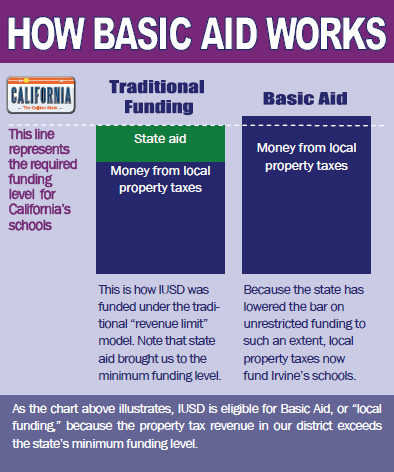
To recap, the Revenue Limit is the pot of unrestricted, general purpose funding that pays for teachers, staff and supplies. And this amount is funded from a combination of local property tax revenue and state aid.
What is Basic Aid?
Basic Aid, also known as "local funding," essentially occurs when the local property tax revenue in a district exceeds the total general purpose funding that the state would have provided. In other words, there's no need to factor in any state aid because the property taxes alone surpass the minimum funding level established by the state.
This doesn't have any impact on taxpayers or specific programs, but it changes the way that dollars are routed, and it used to mean more money.
To view a graphic explaining Basic Aid, click here.
Fair Share Agreement
What is this "Fair Share" agreement I've heard about, and how has it impacted IUSD?
In June 2009, as a result of California's fiscal crisis, pressure began mounting at the state level to further reduce the unrestricted budgets for districts that are funded under the Basic Aid formula. Rather than wait to see what plan legislators devised, a coalition of Basic Aid districts proactively submitted a "Fair Share" proposal, in which they agreed to contribute their "fair share" through categorical contributions. This proposal has cost IUSD millions of dollars over two years, essentially negating any upside the district might have enjoyed as a Basic Aid district.
The bottom line is this: As a result of the precipitous drop in state funding, IUSD has been forced to make approximately $38 million in onetime and ongoing reductions in recent years.
Will the Fair Share payment continue in the years ahead?
More than likely. Based on advice from the Orange County Department of Education and another group that represents Basic Aid districts, IUSD is operating under that assumption.
Reserves
Why do we have to keep a 3 percent reserve?
State law requires districts of our size to maintain an uncommitted reserve of 3 percent of the general fund. During times of fiscal crisis, the state will sometimes allow districts to drop below 3 percent.
A drop in our reserves might sound like a sensible way for IUSD to avoid cuts, but eventually school districts will be required to restore these funds. More important, reducing our emergency reserves would leave us even more vulnerable to the whims of the state, meaning midyear cuts could threaten our very solvency.
It should also be noted that state and county officials advise a much higher reserve level for Basic Aid districts, including IUSD, because their funding levels can fluctuate significantly based on property tax receipts. In traditional Revenue Limit districts, a drop in enrollment means a loss of revenue, but there are protections in place to limit the amount a district can lose in a year. For Basic Aid districts, there are no such protections in place if property tax revenue fell sharply.
Facilities
Can we sell or lease district property to create income for the district?
Selling school property would generate significant income, but unfortunately it would not help our operational shortfall.
Since most of our early schools were built with a combination of local bond money and state dollars, there are a number of restrictions, depending on the particular property. Generally speaking, under the state's complex financing rules, proceeds from the sales of surplus sites must return to the capital budget, which pays for construction and modernization.
Why is the district still building new schools when budgets are tight or short?
Again, there is a sharp legal distinction between dollars used for operating schools and dollars used to build schools. Money designated for school construction cannot legally be used to operate schools.
District staff and the Board of Education will continue to move forward with construction and modernization projects based on the needs of our student population and available resources. It should also be noted that IUSD has realized significant savings on recent construction projects given the current state of the economy. As one example, Stonegate Elementary School came in well under budget.
Can Mello-Roos money be used to address the budget shortfall?
No. Under the provisions of the Mello-Roos law, funds generated can only be used for capital projects and never for operational support.
Can we increase facilities use fees?
Not by much. Because our facilities were built with tax dollars, the law says the public has already paid for them. Consequently, what we're allowed to charge the community in most cases is an amount sufficient only to cover the actual cost of operating the facility during the time of use. The law does not allow us to charge for long-term maintenance or replacement costs. However, we may charge market rates, if the user is a commercial entity.
Categorical Flexibility (Tier III)
What does "categorical flexibility" mean?
"Categorical" funding refers to state dollars that are tied to specific programs. In light of the budget crisis, the state has granted a limited amount of categorical flexibility, meaning some of these dollars can be spent on other high-priority needs. To view a slide presentation with descriptions of what falls under this heading, click here.
What is ROP? How many IUSD students are enrolled?
ROP, short for Regional Occupational Program, offers career-oriented technical education classes, such as computer graphics, automotive technology and video production, for high school students and adults.
Locally, these classes are provided to Irvine students by Coastline ROP through a collaborative agreement that also includes the Huntington Beach Union, Newport-Mesa, Saddleback Valley and Tustin school districts. While the state has historically earmarked dollars specifically for ROP courses, that money is now flexible as a result of the state's budget crisis. In other words, districts can spend their ROP dollars elsewhere if they have more pressing priorities.
In Irvine, approximately 8,850 high school students were enrolled in ROP classes in 2008-09, representing about 30 percent of the district's juniors and seniors. For a breakdown of district enrollment in Coastline ROP, click here.
How many counselors do we have per student in IUSD compared to other districts?
We currently have one counselor for every 450 students in both our middle schools and high schools. Click here for a comparison of IUSD to other Orange County districts.
Furloughs
Exactly what are furlough days? What does it mean for schools to have furlough days?
A furlough day could be defined as a mandatory day off without pay. For school districts, furloughs may or may not result in the loss of instructional days.
What are the pros and cons of furlough days?
Furloughs can equate to the loss of instructional days for students, and they translate into reduced compensation for our employees. Yet they were deemed necessary for IUSD to weather the state fiscal crisis.
Will additional furlough days be needed to balance the budget?
It's not likely.
How much money was saved through previous furlough days?
Our district has calculated a savings of nearly $715,000 per furlough day. By implementing 12 furlough days in 2009-10 and 2010-11, the district saved nearly $8.6 million, negating the need for even deeper program reductions.
Keep in mind that these totals are derived from adjusting the compensation for all employees, including certificated, classified and administrative staff members.
Were administrators and classified staff furloughed?
Yes. All district employees were impacted.
Other Savings
Is it true the Irvine Company provides funding for art, music and science?
Yes. In 2006, the Irvine Company pledged $20 million over 10 years - that's $2 million per year - to IUSD for enriched curriculum in art, music and science in grades four through six. That curriculum amounts to two additional 60-minute science lessons per week; two 40-minute music lessons per week; and six hour-long art lessons per year, all taught by specialists in their respective fields.
As this program has evolved, our district has gradually increased its own contribution to $1.8 million, bringing the total program expense to approximately $3.8 million. This was done primarily to keep pace with rising costs.
Note that the Irvine Company's core enrichment of $2 million per year pays for approximately one 60-minute science lesson per week in grades four, five and six and one 40-minute lesson per week in music. Click here for information about the Art and Music Program considerations and click here for the Science Program considerations.
For years, school districts have been shortchanged by unfunded and underfunded mandates, meaning our schools are required to perform services that they are not reimbursed for. Give our current situation, why don't we refuse to provide these services?
It's true that school districts have historically been mandated to provide services without adequate resources to do so. However, failure to comply with state and federal directives is unlawful and could result in costly litigation, which would only serve to exacerbate our budget challenges.
Why don't we contract out services?
Contracting out is severely limited by the Education Code, court decisions and collective bargaining laws that govern public schools. In simple terms, once the school district has a class of classified employees performing a particular function, that function cannot be transferred to a private sector contract. For those few functions that can be "contracted out," public schools must, by law, use contractors that pay prevailing wage rates and ensure that all employees are properly fingerprinted. These additional requirements, even for contract employees, erode most of the savings that might otherwise be realized by contracting out.
Alternative Revenue
Is IUSD working to bring in additional revenue through fundraising?
Yes. Since 1996, our district has worked closely with the nonprofit Irvine Public Schools Foundation, which raises money for our schools and facilitates many of our most innovative programs, including the Summer Enrichment Program, After-school Classroom Enrichment (ACE), the Instrument Rental Program and the Donald Bren Honors Concert.
In fact, the Irvine Public Schools Foundation is the only organization with the reach and resources to impact every school - and every child - in our district. For more information, click here, or visit www.ipsf.net.
Under what conditions can other groups conduct fundraising to save programs?
A number of groups collaborate with IPSF to address the needs of Irvine students, including our PTAs, the Irvine Company, the City of Irvine, the Irvine Korean Parents Association and businesses such as SchoolsFirst Federal Credit Union, AT&T and Kia Motors.
That said, since the costs of supporting programs are based on contractual obligations, funding must come from an ongoing source rather than one-time efforts. (IPSF's instrument rental program and athletic transportation fees are examples of ongoing fund-raising.)
In addition, it' s important to note that dollars to support programs cannot supplant existing funding. For example, money currently being used to support some element of an athletic program cannot be reassigned to pay for coaching stipends.
Why not ask the Irvine Company for help?
The Irvine Company is a strong supporter of IUSD and has been a very generous donor to the district. In fact, in 2006, the Irvine Company pledged $20 million over 10 years for enriched curriculum in art, science and music in grades four through six.
Acknowledging the Irvine Company is already making a tremendous contribution, education funding is truly the responsibility of the state and the community.
Special Education
How much does IUSD spend on special education?
The Irvine Unified School District spends approximately $41 million serving students with special needs. Meanwhile, the federal government, which mandates these services, only reimburses our district approximately $18 million.
That said, it's important to note that IUSD's special education costs have flattened out in recent years, coinciding with the implementation of intervention strategies such as Response to Instruction, or RtI. These strategies ensure that our schools are meeting the needs of each student, and they're also helping keep costs in check.
Parcel Tax
What about floating a parcel tax to raise revenue? I know that IUSD has been unsuccessful with similar efforts in the past, but is it worth looking into in this economic environment?
A parcel tax will be considered along with other revenue-generating options.